The Wrecking Ball Comes to Thneedville

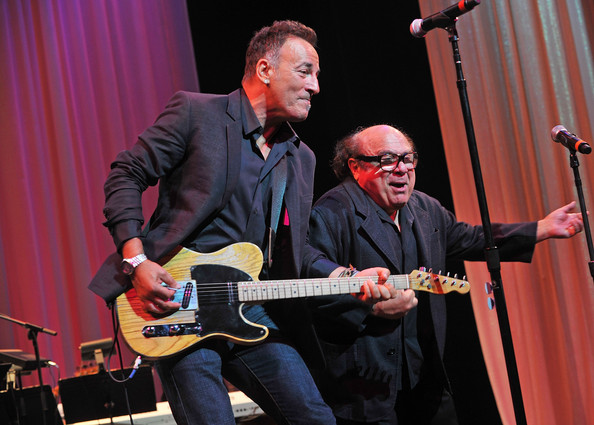
Bruce+Springsteen+Danny+DeVito+3rd+Annual+MDLGxSMMvcfl

Sprinsgteen and Danny DeVito, New Jersey Hall of Fame 2009, Glory Days

By Ryan Hilligoss, March 2012

Springsteen and Devito; The American Bard and The Lorax

In 2008, Bruce Springsteen was elected to the New Jersey Hall of Fame along with such luminaries as Albert Einstein, Toni Morrison, Harriet Tubman and Frank Sinatra. Springsteen was born and raised in blue-collar Freehold, New Jersey, but came of age, both physically and musically, in nearby Asbury Park, New Jersey. Also, from Asbury Park is actor Danny Devito who inducted Springsteen during the ceremony with these words,

” He(Bruce) holds up a mirror to our souls, His words and music allow us to look inside ourselves, allow us to understand how to better deal with life, to better deal with any kind of oppression. And also, of course, he is the first person to step up when there is anguish or any kind of grief and lifts us up and gives us hope.”

Then Springsteen ripped into a live version of his classic, “Glory Days” with Devito accompanying on vocals and air guitar. In 2010, Devito was inducted into the same hall, and who else would be on hand to induct his friend but Springsteen. After which they reprised their on stage performance.

How fitting then that the two New Jersians, both from hard-working, humble roots, have new projects coming out in the same week. Bruce Springsteen’s 17th studio album, “Wrecking Ball”, is set to be released Tuesday, March 6th and Devito is starring in the new Universal Studios production of “The Lorax”, based on the classic Dr. Seuss book.

Each project addresses timely, hard-hitting issues, one on the current economic quagmire facing the nation and its’ suffering citizens, and the other addresses environmental degradation at the hands of greed and moral turpitude. Both works focus on difficult topics, but ask of us, the audience, an important question: What can we do to help solve the problems facing all of us.

While a rock/folk/urban music album and a “children’s” movie may not seem to have a lot in common at first glance, there is more under the surface that we can learn from, but only if we are willing to “listen” hard. A similar idea came to me recently while reading “Woody Guthrie: A Life” by Joe Klein who quotes from John Steinbeck in describing Guthrie’s songs, “He sings the songs of a people and I suspect that he is, in a way, that people…..there is nothing sweet about Woody, and there is nothing sweet about the songs he sings. But there is something more important for those who will listen. There is the will of the people to endure and fight against oppression. I think we call this the American Spirit.”

The Lorax cover

Just for a quick review for the reader, if there are any of you out there swimming through a tidal wave of binary detritus. The Lorax movie, with Devito as the voice of The Lorax, the “hairy peanut”, who speaks for the trees, is based on the book by the same name, written by Theodore Geisel, aka Dr. Seuss, and  first published in 1971. It tells the tale of the Onceler who destroys a beautiful forest of Truffula trees and all the living creatures who once lived there in the pursuit of profits by selling Thneeds that everyone needs, which are made from the fuzzy tops of the Truffula trees. After the Onceler is done chopping down all the trees in the name of “biggering his roads and biggering his factories and biggering his money”, the Lorax takes leave, and all that is left is an ugly, blackened, scorched earth with no Barbaloots or Humming fish to be found.

The Onceler tells a young boy who is on a moral quest to find the truth, “All the Lorax left here in this mess was a small pile of rocks, with one word….”Unless.” Whatever that meant, well I just couldn’t guess. That was long, long ago. but each day since that day, I’ve sat here and worried and worried away. Through the years, while my buildings have fallen apart, I’ve worried about it with all of my heart.”

At the end of the story, on a sign of hope, the young boy asks the old Onceler hermit what happened and what he can do, the Onceler gives him the last remaining Truffula seed with instructions to “plant a new Truffula, treat it with care, give it clean water and feed it fresh air.”
springsteen-wrecking-care

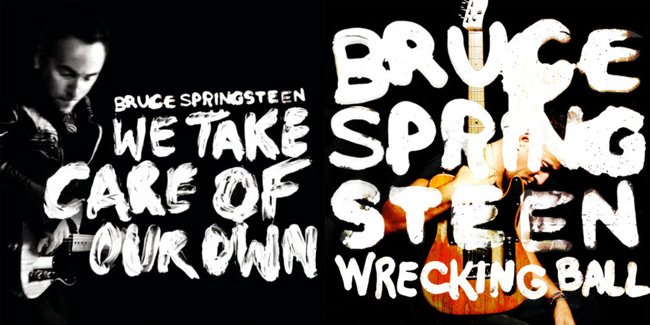
Whereas “The Lorax” looks at the dangers of “progress” and destruction of the physical environment, Springsteen’s Wrecking Ball album takes a hard look at the scorched earth that remains of our “shackled and drawn” economy and the millions of suffering citizens. The album opens with an anthemic “We Take Care of Our Own” that is an upbeat mix of rock and flag waving that will surely be mistaken by some, just as Born in the USA was mistaken back in the 80’s, as patriotic and jingoistic instead of a scathing indictment of the current social and governmental failure to care for our citizens.  Instead of making a bold proclamation, the song and lyrics are asking a question,” Do we really take care of our own?”, and by listening to the rest of the album, his answer is steadfastly….. no!!!

The entire album plays as a straight Greek tragedy, but the story here is not a fairly tale or a play written long ago. It is a modern tale of hard times for hard-working people, to paraphrase Pete Seeger, many of whom have been left behind in the wake of the economic depression that has occurred in the last 5 years here in America, and all around the world. The first half of the album tells the story of the difficult, almost soul crushing times and circumstances facing many, through songs such as Easy Money, Shackled and Drawn, Jack of All Trades and This Depression. The second half the album with the songs Wrecking Ball, Rocky Ground and We Are Alive leads us to a more hopeful place, a place where we live up to the ideals we hold in our hearts.

In “Death to My Hometown”, a hard charging, Irish rocker, Springsteen sings from the view-point of a citizen who has lost all that is near and dear during the second great depression. The narrator has lost his job and his home through normal channels of modern business wherein jobs are stripped away and sent overseas or just stripped away altogether, leaving a wide path of emotional, social and communal destruction in its wake. Springsteen sings:

Now no cannonballs did fly

No rifles cut us down

No bombs fell from the sky

No blood soaked the ground

But just as sure as the hand of god , they brought death to my hometown

They destroyed our families and factories,

And they took our homes

In answer to these actions, committed by an enemy he cannot see, the narrator tells his assembled audience of fellow citizens that the enemy will be back again and to get ready.

Now get yourself a song to sing

And sing it til’ your done

Sing it hard and sing it well

Send the robber barons straight to hell

After the last lyric is sung , there is  a sound of a shotgun being loaded (actually an AK-47 per album liner notes) and an explosion of drums which comes across as a call to arms. Not a call to become armed and loaded and to take violent action, but a call to link arms in solidarity to fight the bastards, whoever they might be. When Springsteen sings about getting a “song to sing and sing it til’ your done”, it stands as a call to action for all of us. Or as a form of call and response. A call for each of us to find a “song”, whatever that might be for each of us as individuals to respond in the best way we can based on our abilities, whether it be an actual song if you have any musical talents, or to write a letter or an opinion piece, or to take better care of friends or family, or to take political action or to organize others to help fight for a cause near to your heart. Find your song and sing it well and sing it hard my friends.

Yes, on one level, Wrecking Ball and The Lorax are talking about economic and environmental woes and the dangers of venture capitalism and immoral companies. But, if you follow the earlier advice of  Steinbeck and listen harder, you might hear the sound of the American spirit. A spirit thundering down the tracks, and a spirit that says, in Walt Whitman’s mighty yawp,”We Are Alive.”

In asking if we take care of our own, you might find the answer is no. Then you might ask yourself, what can I do to help others around me who may be suffering. But, more importantly, what help do I need, which often times can be even harder to admit to others or to yourself.

You may not find the answers right away or, possibly, ever, but just by asking the questions and searching for solutions or reaching out for help, you can take the first step on a long journey to a better place, a land of hope and dreams. Until then, plant your own “Truffula Seed”. Get yourself a song to sing and sing it hard. For as the Onceler tells the young boy in The Lorax:

UNLESS someone like you

cares a whole awful lot,

nothing is going to get better.

It’s not.

(Editor’s note) ***The Lorax is currently playing in theaters, and is highly recommended by someone who saw it this weekend with his family. The movie is quite enjoyable even for those of you who don’t enjoy animated movies. Wrecking Ball comes out March 6th. Check out the rave review from Denis Lehane, author of Mystic River and Gone Baby Gone:

“Wrecking Ball is possibly Bruce’s best album in a quarter century, for what my opinion’s worth. It’s bracing and subversive and sonically fearless. It’s going to give voice to a generation, certainly to an era. In that regard, I would put it shoulder to shoulder with Born To Run, Highway 61 Revisited, Exile on Main Street, London Calling and American Idiot. Indelible. I stand in awe of Bruce’s ability make music this angry and relevant and authentic at any stage of his career, nevermind 40 years on. Thank God for him.”

A Beautiful Dreamer

Image

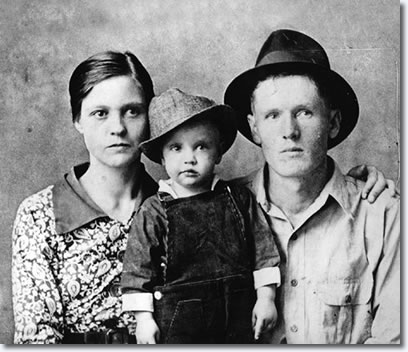
Elvis Presley age 3 with Gladys and Vernon Presley

Beautiful Dreamer

By Ryan Hilligoss, February 2012

“Believe in the beauty of your dreams.” Eleanor Roosevelt

As a way of introducing myself with my first blog posting, here is a list of just a few of my heroes: Chuck Berry, Robert Kennedy, Louis Armstrong, Abraham Lincoln, Miles Davis, Kurt Vonnegut, Elijah Lovejoy, Jane Addams, Larry “Studs” Terkel, Eleanor Roosevelt, Bruce Springsteen and Elvis Presley. Yes….that Elvis Presley. The man who sadly, now is seen by many as a punch line to a joke about an overweight, doped out gun toting recluse who died in an undignified manner. A man whose death set an unfortunate precedent for many other celebrities, including Michael Jackson and Whitney Houston.  But to me, Elvis was a beautiful dreamer and a musical and cultural trailblazer with a moral to teach all of us.

Just read what renowned rock critic Dave Marsh wrote in his profound work simply titled, Elvis, “Somewhere, out of all of this, Elvis began to seem like a man who had reached some conclusions. And so he was made into a god and a king. He was neither- he was something more American and, I think, something more heroic. Elvis Presley was an explorer of vast new landscapes of dream and illusion. He was a man who refused to be told that the best of his dreams would not come true, who refused to be defined by anyone else’s conceptions.

“That is the goal of democracy, the journey on which every prospective American hero sets out. That Elvis made so much of the journey on his own is reason enough to remember him with the honor and love we reserve for the bravest among us. Such men made the only maps we can trust.”

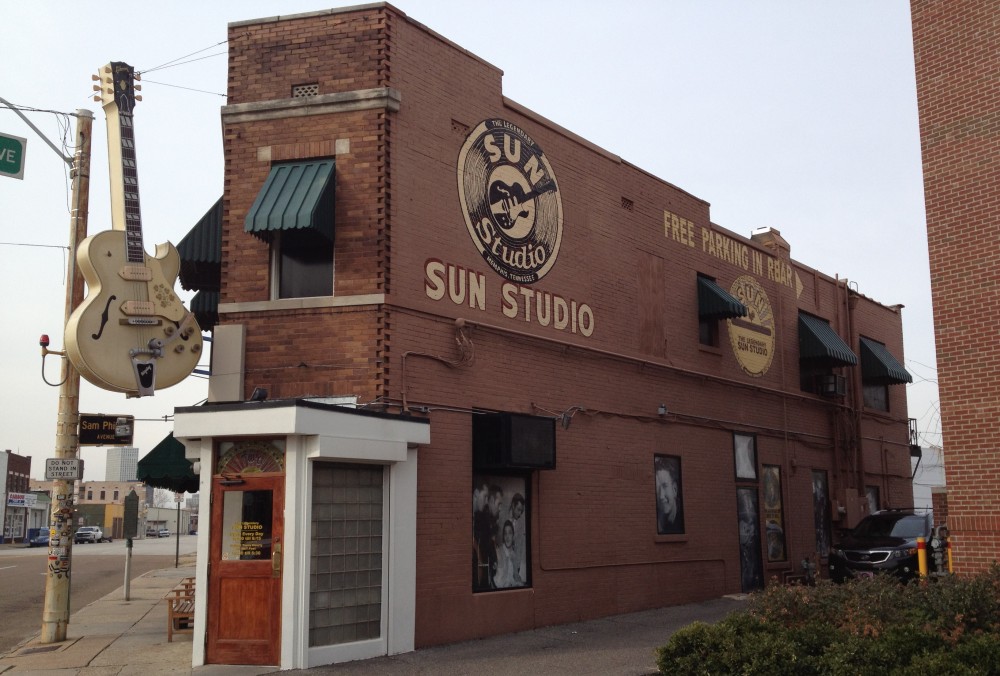
I take the name of my blog from an address. 706 Union Ave.An address not nearly as well known as 1600 Pennsylvania Ave,10 Downing Street, or 11-21 Wall Street, but ultimately 706 Union Avenue is significantly more powerful than all others in terms of social and cultural meanings. 706 union Ave, Memphis, Tennessee, USA is the home of the original Memphis Recording Service that ultimately became Sun Records, proving ground of musicians from all over the country and whose blend of gospel, country, blues, bluegrass, and rhythm and blues became rock and roll, one of America’s greatest art forms and one of our most important exports, behind only democracy and jazz.

Sun exterior

Sun Studios was founded by the visionary Sam Phillips, a man who wanted to broaden cultural and social integration by combining the music of both black and white into a new form of music that would reach everyone. Phillips was a southerner who chose Memphis to setup his business as it was a focal point of national migration, travel and commerce. Virtually all of the artists who he discovered came from the deep south and brought their varied music roots with them and formed a rich and diverse musical landscape.

Over a brief span of roughly 10 years, Phillips recorded a wide range of musicians starting with a very young Riley “BB” King, Jackie Breston, blues legend Howlin’ Wolf, Elvis Presley, Johnny Cash, Rufus Thomas, Jerry Lee Lewis, Junior Parker, Carl Perkins and Roy Orbison.  Jackie Breston’s Rocket 88, an ode to a hot Oldsmobile automobile, is viewed by many as the first rock and roll record with  simple boogie riff with underlying piano and sax instruments. Described in Good Rockin’ Tonight as “…raucous, unbridled energy that certainly foreshadowed much that was to follow, although arguably it owed a greater debt to what had come before.”

Phillips said that he was trying to open up an area of freedom within the artist himself. Upon hearing Howlin’ Wolf for the first time in the studio, Phillips stated, “When I heard him, I said, this is for me. This is where the soul of man never dies.”

Sun exterior long

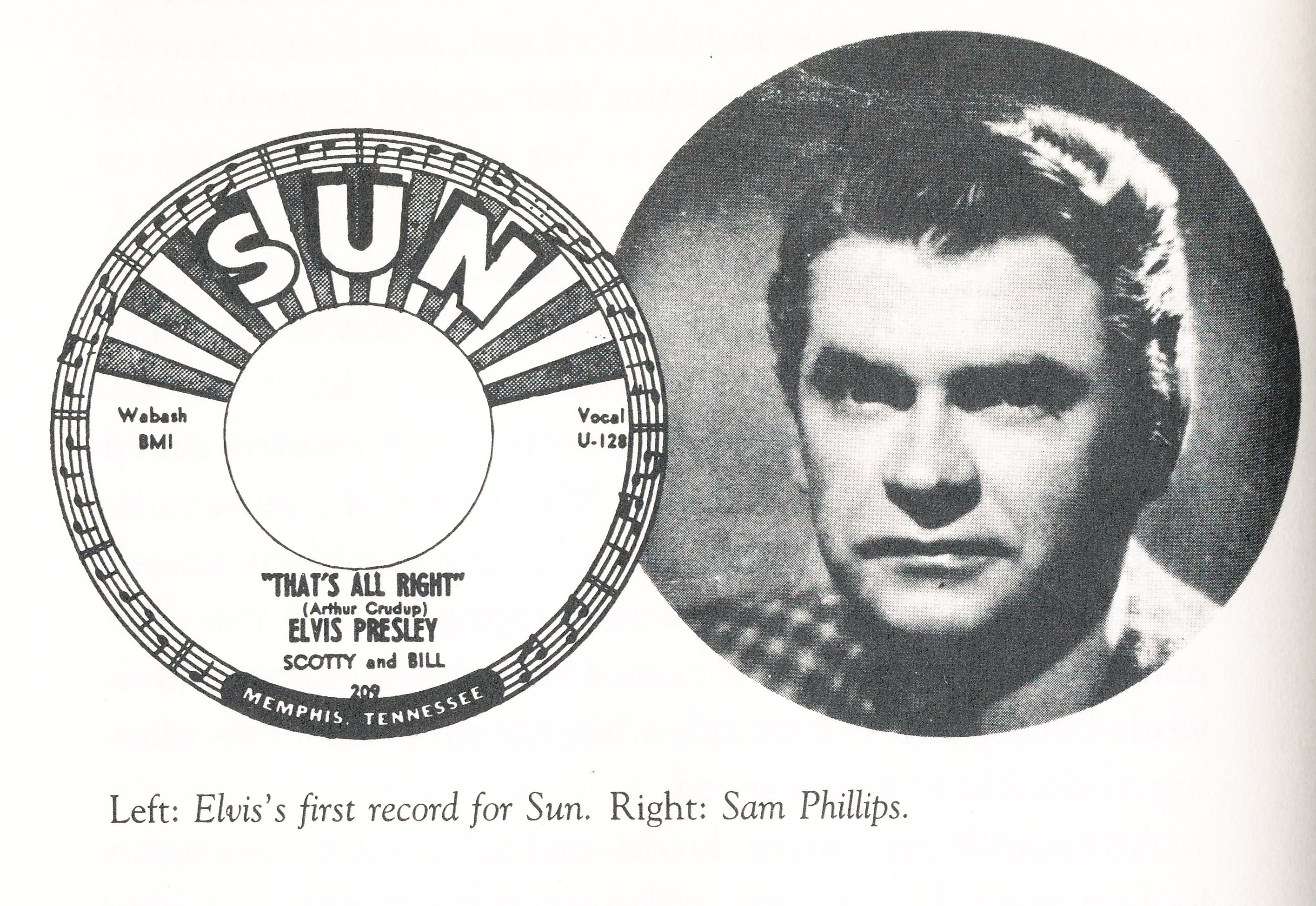
Elvis Presley’s recordings for Sun Records included Mystery Train, That’s All Right Mama, Good Rockin’ Tonight, Baby Let’s Play House. These are some of the most important musical recordings in American music that helped start the new form of rock and roll but also played an integral part in social and cultural changes including, most importantly, the civil rights movement. Phillips has been quoted endlessly as stating he wanted to find a white singer who could sound black in order to reach white audiences with what was then termed “race music.” In Elvis he found the perfect candidate. Many listeners and radio stations were fooled into thinking Elvis was actually black and many stations refused to play his records because of that reason. Elvis recorded with Sun Records until 1956 when Phillips sold his contract to RCA records and Elvis became “The King.” (Ironic since before recording with Sun, Elvis was driving a truck for Crown Electric.)

But with his swaying hips and curling lips and his performances on national television, including Dorsey Brothers, Steve Allen, Milton Berle and more famously the Ed Sullivan Show, Elvis reached millions of fans and became the most popular American folk hero of the 20th century. For what you may not know is that Elvis Presley came from one of the most humble backgrounds. He was born to poor southern parents, Gladys and Vernon, in a shotgun shack inTupelo,Mississippi during the heights of the Great Depression. His father struggled so hard to provide for his small family that he tried to forge a check to buy groceries and was sentenced to three years in a state penitentiary, during which time Gladys took in laundry and tailoring to make ends meet.

It was there in East Tupelo, that Elvis grew up on the poor side of town amongst both black and white. And it was there that he was exposed to the music that would inform him for the rest of his life and career and helped ingrain all the various components that made up his music later in life. He heard blacks play their blues on their front porches. He heard and sang the gospel songs he grew to love while attending church every week with his parents. He listened to the Grand Ol’ Opry and it’s eclectic mix of country, gospel and bluegrass on the radio every weekend. On his eleventh birthday, he asked his mom for a rifle, but Gladys was afraid of the rifle and she bought him a guitar instead. The rest is history as Elvis climbed from the depths of poverty and reached the heights of worldwide fame and the continued devotion and adoration of fans  who travel the world over to Memphis to pay their respects, 35 years after his death.

Elvis Presley age 12

Elvis Presley age 12, Tupelo, Ms

In 1970, as an introduction to the great song, Walk A Mile in My Shoes, Elvis quoted part of an old Hank Williams song:

You never stood in that man’s shoes, or saw things through his eyes

Or stood and watched with helpless hands, as the heart inside you dies

So help your brother along the way, no matter where he starts

For the same god that made that made you, made him too

These men with broken hearts.

At the top of this post is a picture taken of Elvis with his parents. In the picture, Elvis is maybe three years old and he stands on a table with Gladys and Vernon on either side. He is wearing a pair of worn, soiled overalls and a fedora hat pulled down at a jaunty angle. In his face, you can see traces of the pouty lips and the darkened, bee stung eyes that would eventually make him the second most globally recognized face, second only to Mickey Mouse. It is a picture that symbolizes how far he came in life. It also symbolized how far many other came during that same time. As his story is very similar to that of my own families as both sets of my grandparents came from very similar backgrounds around the same time. What you can see in those faces is a burning desire to live a better life and to provide better dreams for their kids. Even though my grandparents and parents never achieved world wide fame, they all fought the good fight and came to embody the meaning of the American Dream.

In his extraordinary work on Elvis, Careless Love, author and music historian, Peter Guralnick writes “…in the end, there is only one voice that counts. It is the voice that the world first heard on those bright yellow Sun 78s, whose original insignia, a crowing rooster surrounded by boldly stylized sunbeams and a border of musical notes, sought to proclaim the dawning of a new day. It is impossible to silence that voice…”

“He(Elvis) continued to believe in a democratic ideal of redemptive transformation. He continued to seek out a connection with a public that embraced him not for what he was but for what he sought to be.”

1956_june_30_elvis_and_a_young_fan

Elvis Presley with young fan, playing the drums, 1956

To tie this all together, in 1978, after enduring a struggle for his own artistic freedom with his first manager, Bruce Springsteen wrote a song called the Promised Land for the album, Darkness On The Edge of Town. Whether directly or indirectly, it shared the same title of a song written by one of his, and countless other’s, musical heroes, Chuck Berry, a man from a poor family living in a segregated St.Louis, Mo. Chuck’s version, written in 1964 and possibly influenced by Martin Luther King’s I Have a Dream speech in 1963, was about a poor southern boy dreaming of a better life in California and struggling to make his way across the country in search of that journey. In the later stage of his career, Elvis recorded Berry’s Promised Land and turned it into one of his last great rock recordings.

After the failure of the Bay of Pigs operation in 1961, President Kennedy stated, “Success has a 100 fathers while failure is an orphan.” Rock and roll was and remains a great success on inummerable levels, not a failure by any definition. And Elvis Presley and Chuck Berry, in my mind, were two of the most influential “fathers” of rock and roll, one of the great unifying forces in modern American life and one that greatly influenced the civil rights movement. Elvis’ first recordings took place in a small Memphis studio called Sun Records which, ironically enough, was situated at 706 Union Ave. We could use a little more unity in our communities, in our states, in our country and across the world today.

The sooner we can all recognize the need for understanding our common problems, discussing them in an intelligent and fair manner and attempting to find some common ground, the sooner we can start living up to the ideals our nation stands for. The ideals that caused so many to risk it all, to make that journey across the water so they could start their hopeful wandering. Oh, I believe in the Promised Land.

I will leave you for now with a sign off that can be traced to Woody Guthrie, but one I first heard from another of my literary, cultural heroes, Studs Terkel who signed off from his radio show everyday with, “Take it easy, but take it.”

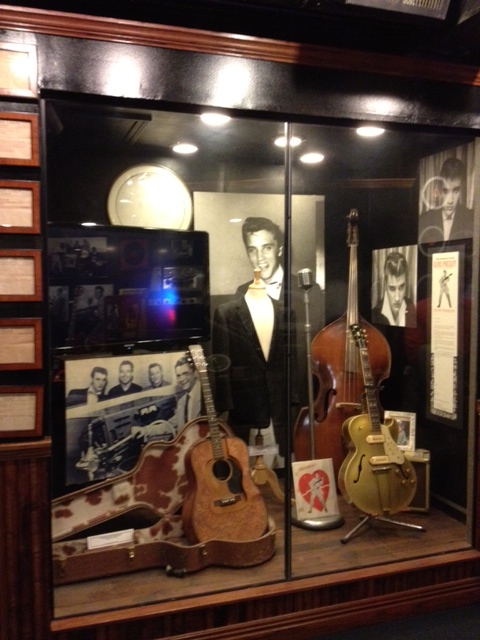
Sun museum interior

Sun Studio museum, Memphis, Tn. Notice the leather guitar cover Elvis used in the 50s to keep his belt from scratching the wood when he danced on stage